

The Real Savoca: Beyond The Godfather
The hilltop village Francis Ford Coppola made famous — and the authentic Sicilian heritage that existed long before the cameras arrived.
Introduction
“Every year, thousands of travelers make the pilgrimage to a small medieval village perched 300 meters above the Ionian Sea.”
A Thousand Years on a Hilltop
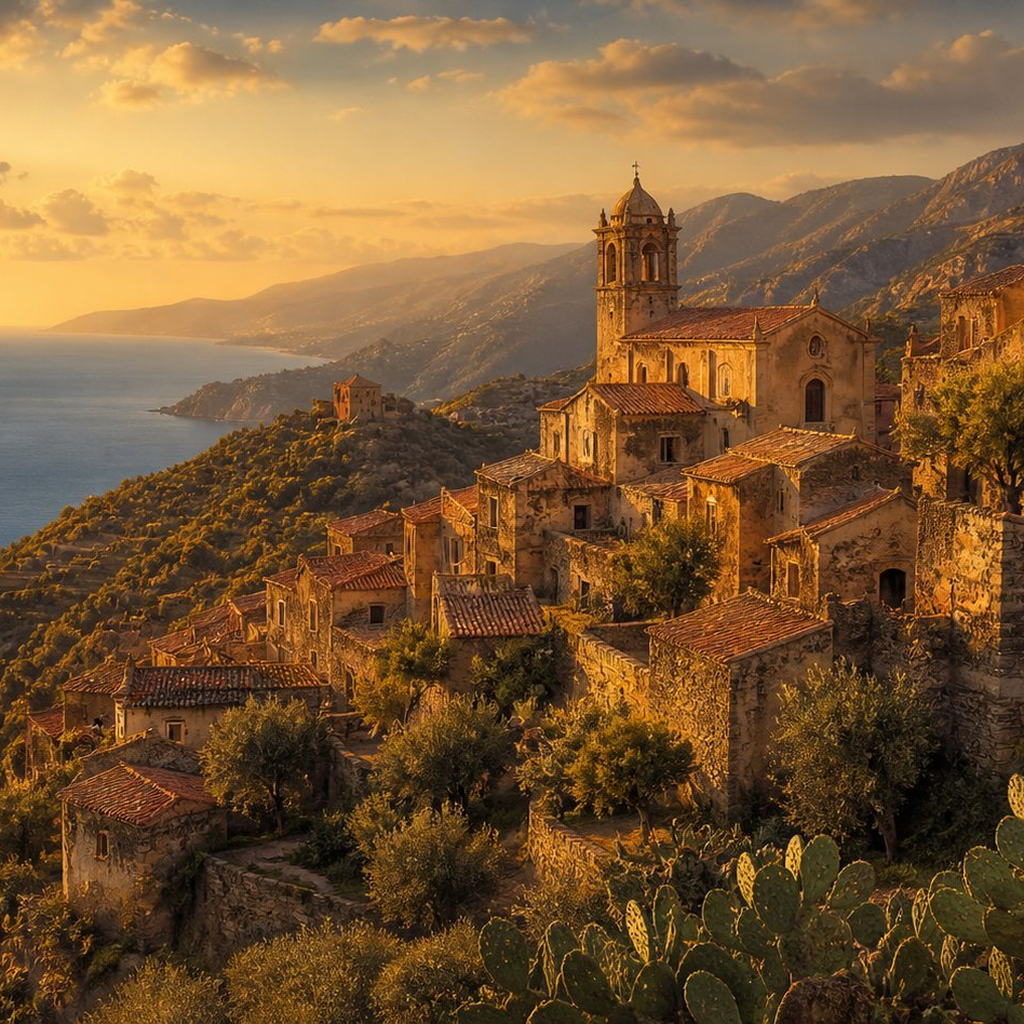
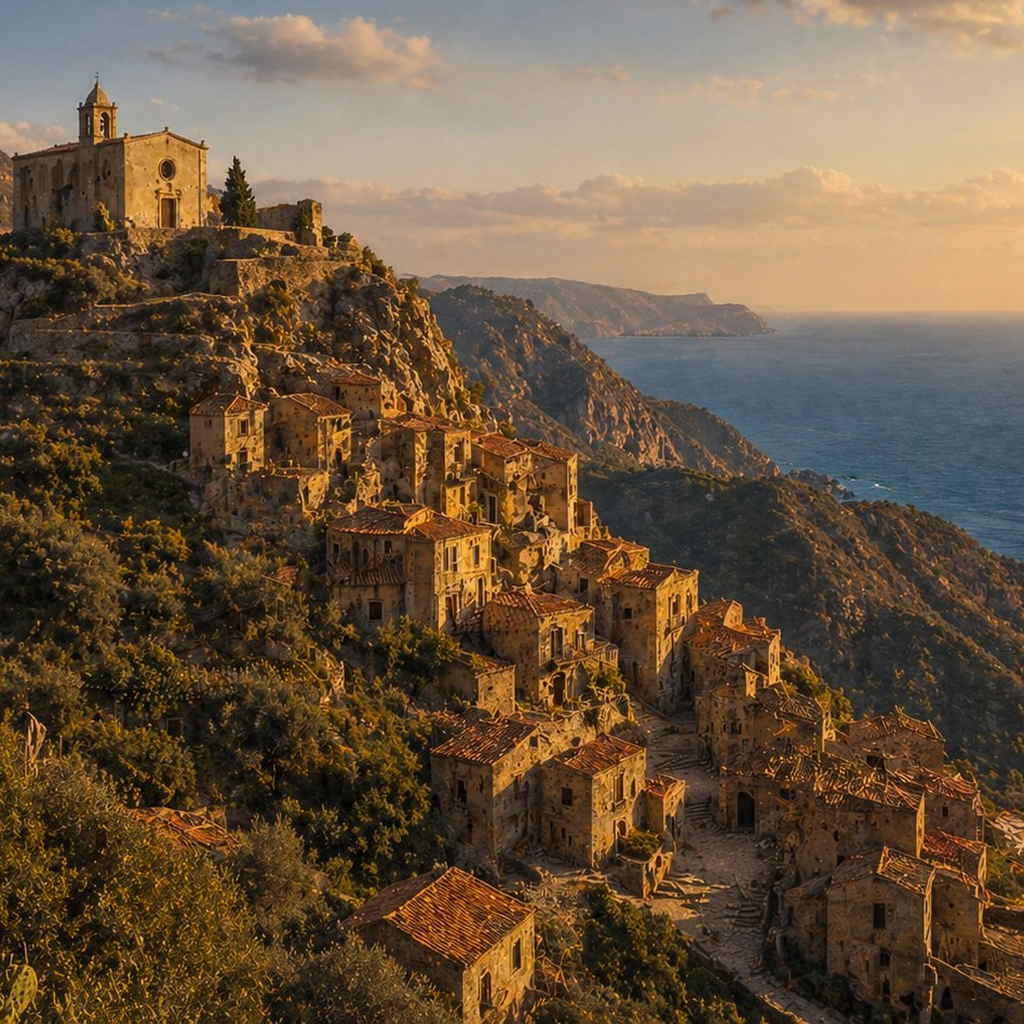
Savoca was likely founded in the 12th century, during the Norman period, as a fortified refuge for the population of the coastal area below. Its position on a narrow ridge offered natural defenses against the raids — pirate, Saracen, and later Ottoman — that plagued the Sicilian coast for centuries. At its medieval peak, Savoca had perhaps 3,000 inhabitants and nine parishes. Today the permanent population is less than 200, though the village swells with tourists and descendants of emigrants in the summer months.
The village sits in the Province of Messina, in the Val Demone region of northeastern Sicily. To reach it, you climb a winding road from the coastal town of Santa Teresa di Riva. The ascent itself is part of the experience. Each switchback reveals a new view — the Ionian Sea stretching to the horizon, the Peloritani mountains rising behind, the terraced olive groves and vineyards that have fed Savoca’s families for centuries. When you reach the village, you understand immediately why medieval Sicilians chose this site: it commands a view of everything that matters.
Why Coppola Chose Savoca
Francis Ford Coppola’s original plan was to film the Sicilian sequences of The Godfather in the village of Corleone itself — the town whose name the Corleone family carries in the film. But Corleone in 1971 had been transformed by modernization: the old stone buildings had been renovated or rebuilt, the medieval atmosphere was gone, and the village no longer looked like the timeless Sicilian mountain town the script required. Coppola’s location scouts searched across Sicily for a village that still looked the way Sicily did in the 1940s.
They found Savoca. With its preserved medieval architecture, its narrow stone streets, its quiet piazzas, and its location high above the coastline, the village was perfect. The film crew used four locations in Savoca: the Church of San Nicolò (where Michael and Apollonia’s wedding is filmed), Bar Vitelli (where Michael meets Apollonia’s father), the village fountain, and various stone streets and alleys. They also filmed exterior shots in the nearby village of Forza d’Agrò. Between them, these two villages provided all the “Corleone” sequences in the film.
WHAT TO SEE IN SAVOCA
Bar Vitelli
The most famous location in Savoca — the place where Michael Corleone asks about Apollonia, where her father sits at a table, where Michael is told in carefully measured Sicilian dialect that Apollonia’s father has a daughter. Bar Vitelli is still a working café. It still serves the granita di limone that was on the original menu. The family that runs it is descended from the same Vitelli family that owned the bar when Coppola filmed there. Framed photographs of the film production, signed memorabilia, and Godfather ephemera fill the walls. Order a granita. Sit at one of the outdoor tables. Watch the light move across the stone piazza as it has for centuries.
Church of San Nicolò
The Capuchin Crypt
Below the village’s Capuchin monastery lies one of Sicily’s most haunting sites: a crypt containing the mummified remains of local nobles and clergy, preserved through a now-lost technique used by the Capuchin friars between the 17th and 19th centuries. The bodies, dressed in period clothing, stand in alcoves along the walls. The experience is not for everyone, but for those willing to visit, it is an extraordinary encounter with Sicilian history — a reminder that the dead in Sicily are not forgotten, that ancestors remain present, that the past never fully passes.
The Medieval Streets
Savoca’s greatest treasure may simply be the village itself. Walk the stone streets. Enter the small piazzas. Look at the carved stone doorways and the inscriptions above them. Notice the tiny shrines built into street corners. Listen to the sound of your own footsteps on stone that has been walked by generations. This is the Sicily that existed before Hollywood arrived — and that still exists today, for anyone willing to look.
Joseph's Connection to Savoca
From the Author — Joseph Sturiale
Joseph Sturiale was born in Santa Teresa di Riva, the coastal town directly below Savoca. His family emigrated to the United States just before his second birthday, but his connection to this stretch of the Sicilian coast is deep and personal.
The cliffs above Santa Teresa, the winding road up to Savoca, the view from the village square — these are not abstract tourist attractions for the author. They are the landscape of his earliest heritage, of the family he returns to visit, of the generations of Sturiales who lived in these villages long before the Corleone family was ever written into a novel.
The author’s chapter on Sicilian emigration in Sicilian Odyssey draws directly on his family’s experience leaving this part of Sicily for America in the mid-20th century — a story that, in various forms, was shared by more than a million Sicilian families during the Great Migration.
How to Visit Savoca
Getting There
Savoca is approximately 45 minutes by car from Taormina, the most popular tourist base on Sicily's east coast. Coming from the coastal autostrada (A18), exit at Roccalumera or Santa Teresa di Riva and follow signs upward. A free parking area sits at the edge of the village; all main sites are within easy walking distance.
Best Time to Visit
Spring (April–June) and early autumn (September–October) offer the best balance of weather and manageable crowds. The village is extremely popular in July and August, when queues for Bar Vitelli can stretch into the piazza. Winter visits offer quiet contemplation but some businesses close seasonally.
What to Do Nearby
Forza d'Agrò — Godfather filming location, 20 min away, equally beautiful, less crowded Santa Teresa di Riva — the author's birthplace, with excellent seafood Taormina — Greek theatre, Belvedere, Corso Umberto Mount Etna — Europe's most active volcano, 90 min away Castelmola — hilltop village with spectacular views
Give it the respect it deserves.
The film industry discovered Savoca in 1971. But Savoca discovered itself a thousand years earlier. When you walk these streets, remember: you are not visiting a movie set. You are visiting a Sicilian village that has endured earthquakes, pirate raids, plague, poverty, emigration, and modernization — and that is still here. The Godfather is a beautiful film. Savoca is a real place. The film is two hours long. The village has been here for a thousand years. Give it the respect it deserves.