

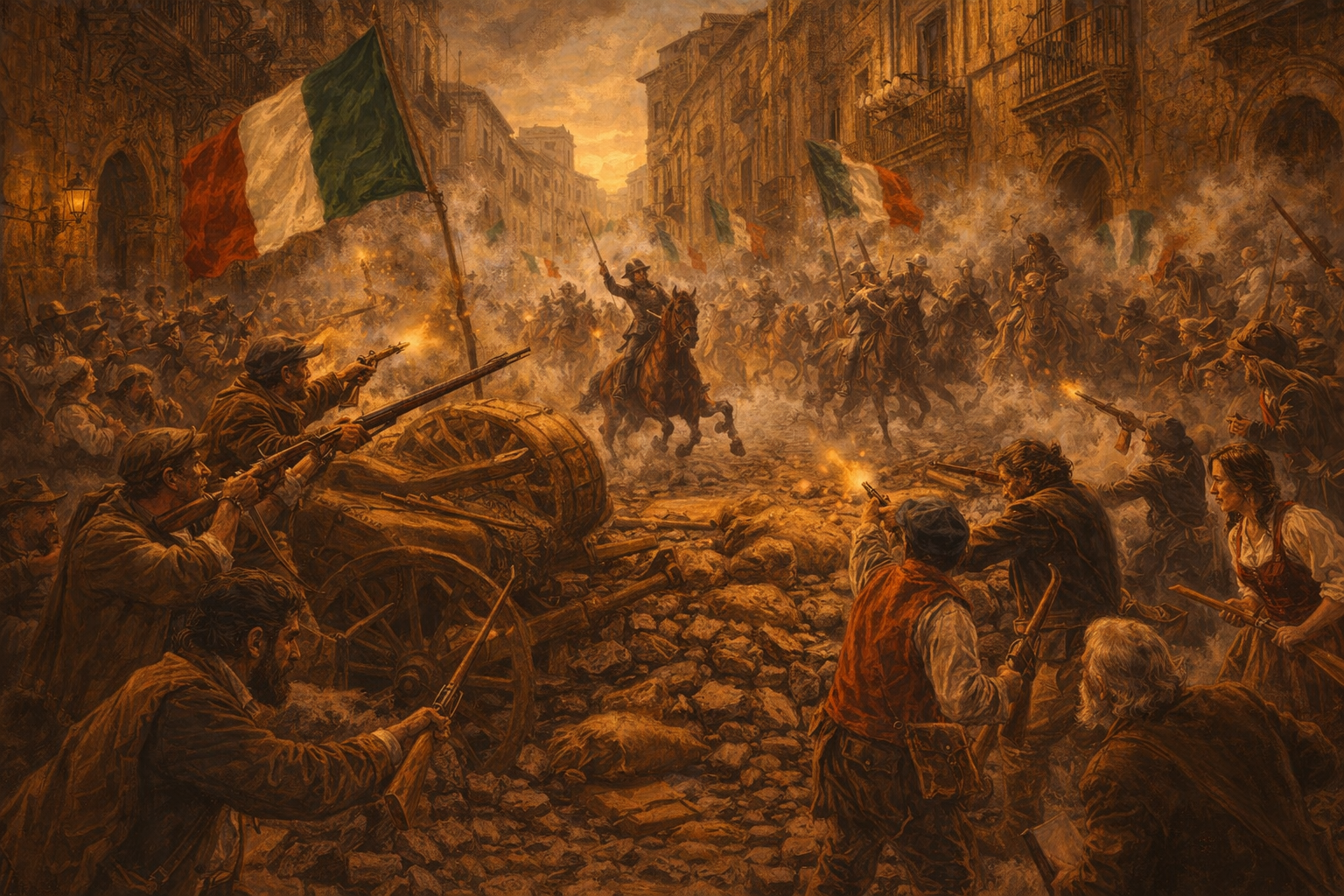
The year 1848 is known in European history as the “Year of Revolutions.” Beginning in Sicily in January 1848, popular uprisings swept through France, Germany, Austria, Hungary, Italy, and beyond, challenging the conservative monarchial order that had dominated Europe since the defeat of Napoleon in 1815.
The Sicilian revolution of 1848 was remarkable in several ways. It was one of the most successful of the European uprisings of that year in its initial phase: within weeks, the Bourbons had been driven from Sicily and an independent Sicilian state had been proclaimed. A provisional government established a constitution, organized elections, and began the work of building a sovereign Sicilian nation. For nearly 16 months, Sicily was politically independent for the first time in more than half a millennium.
But the Sicilian revolution, like most of the 1848 uprisings, was ultimately defeated by the conservative military forces of the various European monarchies. The Bourbons soon recovered their position in Naples and launched a military campaign to retake Sicily. Bourbon forces bombarded Messina in September 1848 (earning King Ferdinand II the infamous nickname “La Bomba) and gradually reconquered the island over the next year. By May 1849, the revolution had been crushed, the Bourbons were back in control, and thousands of revolutionaries had been imprisoned or exiled. But the memory of those 16 months of independence did not die. Twelve years later, when Garibaldi landed at Marsala, he found a Sicilian population ready to take up arms against the despised Bourbon regime once more.